Your Loan Options
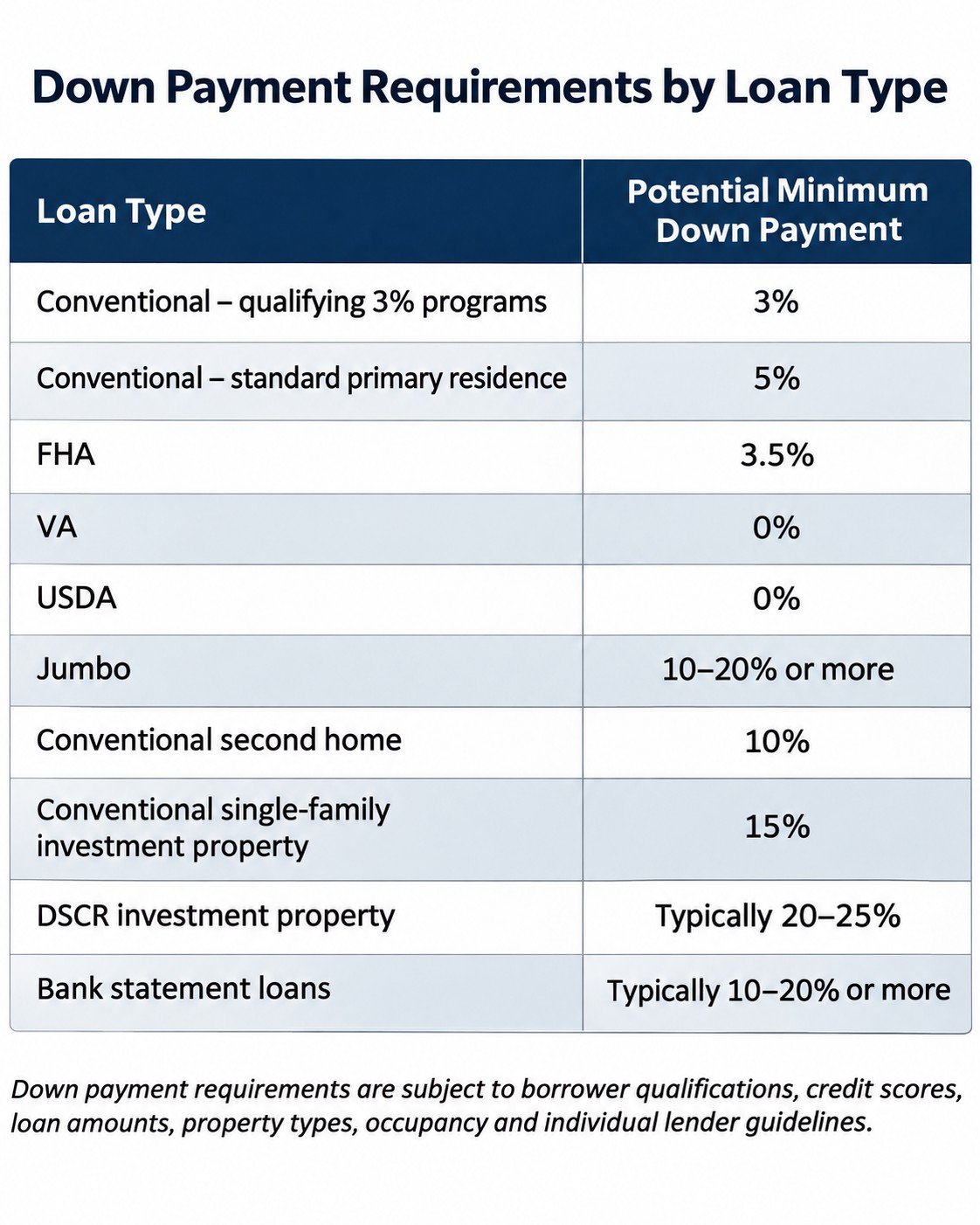
Conventional Loans: First time homebuyers can get in with a minimum of 3% down. Private mortgage insurance (PMI) is required when putting less than 20% down.
FHA Loans: Min down payment is 3.5%. FHA loans offer more flexible credit qualifying guidelines and typically the interest rate is about 0.5% lower than Conventional financing; however, mortgage insurance can be double that of Conventional depending on your credit score.
VA Loans: VA loans offer the potential for zero down payment with no monthly mortgage insurance. A VA funding fee may apply.
USDA Loans: These loans offer zero down payment financing, subject to household income and property eligibility requirements.
Jumbo Loans: Some programs allow as little as 10% down, depending on the borrower's financial profile.
DSCR Loans: Designed for real estate investors, these loans primarily evaluate the property's rental income relative to its debt obligations rather than relying on traditional personal income calculations.
Bank Statement Loans: An alternative financing option for self-employed borrowers who may benefit from qualifying through bank statement deposits rather than traditional tax return income.
Where Can Your Down Payment Come From?
Depending on the loan program, acceptable sources may include personal savings, proceeds from the sale of real estate, gift funds from family members, gift of equity, eligible retirement or investment accounts and down payment assistance programs.
It is important to understand how these funds must be documented before moving money between accounts.
Is a Larger Down Payment Always Better?
Not necessarily.
While a larger down payment may reduce your monthly mortgage payment, improve loan pricing and eliminate private mortgage insurance on conventional financing, there is also value in maintaining liquidity.
Consider what else your money could accomplish: maintaining emergency reserves, making home improvements, paying off higher-interest debt, preserving investment opportunities or maintaining capital within your business.
Remember, your down payment is not your entire cash requirement. Closing costs, prepaid expenses and potential reserve requirements should also be considered.
Think Beyond the Down Payment
The conversation should not simply be about how much money you need to purchase real estate, but rather how much money makes sense to put into real estate.
A mortgage should be structured around your broader financial goals, not simply your ability to qualify.
Before deciding how much to put down, let's explore your financing options and determine which strategy best serves your financial future.
Borrow strategically. Purchase wisely. Preserve financial flexibility.